

Have you ever noticed how your heart races when you’re startled, or how your breathing slows down the moment you hit the couch after a long day? You didn’t "tell" your heart to speed up, and you didn’t command your lungs to relax.
This is the work of the Autonomic Nervous System (ANS), the sophisticated, behind-the-scenes operator of your body. Let’s break down how this system keeps you alive without you ever having to lift a finger.

Breaking Down The Complexities of our Nervous System
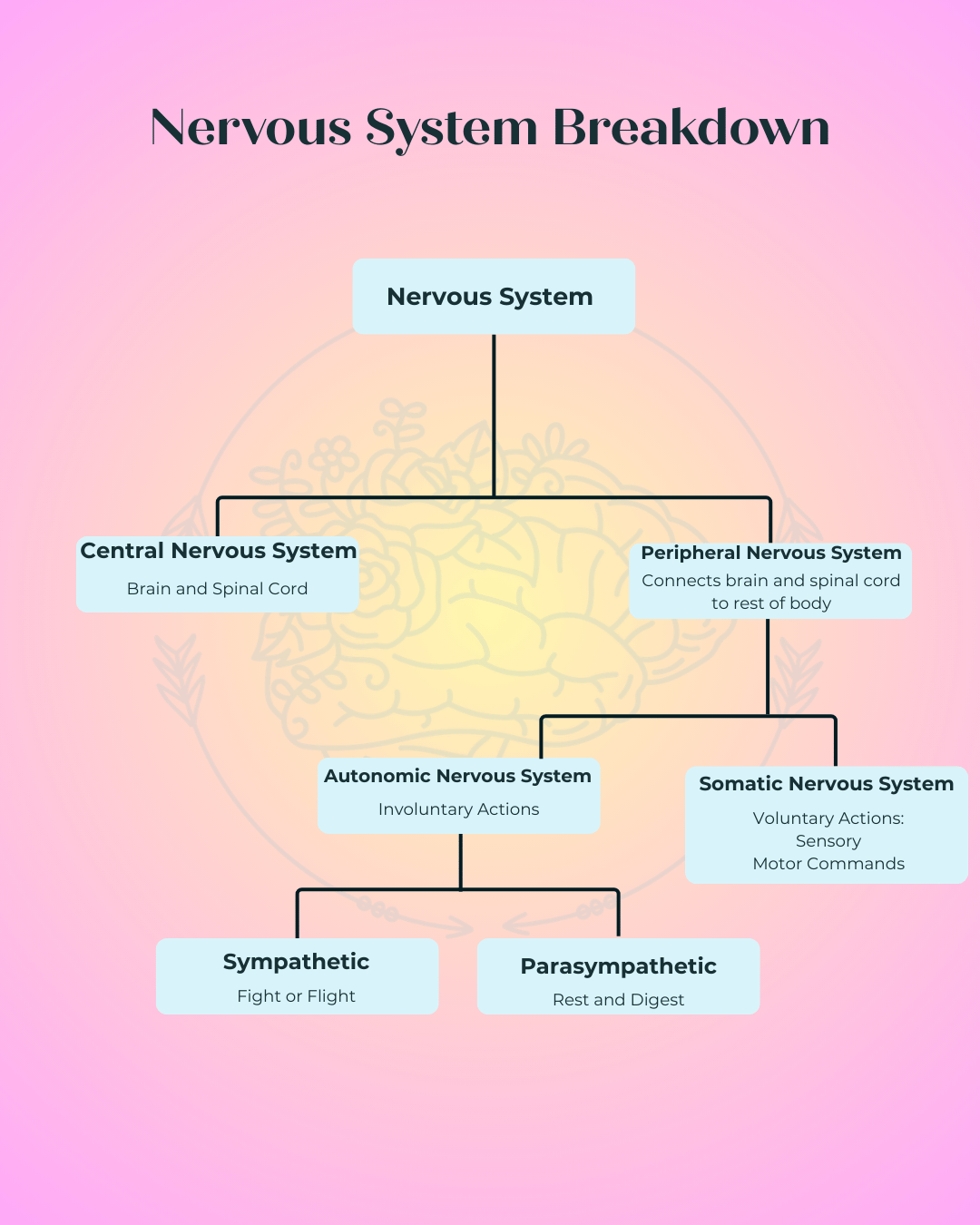
This image breaks down the overall structure and complexities of our nervous system.
What Does “Autonomic” Actually Mean?
Autonomic sounds like automatic for a reason. The Autonomic Nervous System (ANS) is your 24/7 autopilot that quietly manages processes you don’t actively think about, things like heart rate, blood pressure, digestion, sleep cycles, and sweating.
The Tale of Two Systems:
The ANS is divided into two branches that act like a "gas pedal" and a "brake." They are constantly working in opposition to maintain internal balance (homeostasis).
The Sympathetic Nervous System (The Gas Pedal)
This is your "Fight or Flight" response. It originated in the middle of your spinal cord and is designed to help you survive a perceived threat.
The Reaction: Your heart rate spikes, your pupils dilate to let in more light, and blood is diverted away from your gut and toward your leg muscles.
The Goal: Moving energy from "maintenance" to "movement" (like running away from a bear or a stressful meeting).
The Parasympathetic Nervous System (The Brake)
This is your "Rest and Digest" response. These nerves mostly originate from your brainstem and the very bottom of your spinal cord.
The Reaction: Your heart rate slows down, your pupils constrict, and blood flow returns to your digestive tract.
The Goal: Conserving and storing energy. This is when your body repairs itself and processes nutrients.
Balance Between The Two Systems
In our modern, high-alert world, many of us are "Sympathetic Dominant." We treat emails like predator attacks and deadlines like life-or-death struggles. In an ideal world we should be able to pivot smoothly between these two states. It’s the "flow" that allows you to be sharp and focused during a presentation, then completely relaxed and present at the dinner table.
When this balance is disrupted, the scales get stuck. This autonomic dysregulation means your body loses its agility; you might find yourself tired but wired, unable to shut off the mental engine even when the "threat" has passed. Over time, a nervous system that can't find its way back to center doesn't just feel stressed, it becomes exhausted.
How to Assess Your Body’s Balance:
Heart Rate Variability (HRV) is an objective measure that assesses the readiness of your nervous system. HRV measures the variability between heart beats. Surprisingly, a "steady" heart like a metronome isn't the goal. A healthy, resilient heart actually has a high degree of variation; it’s constantly making micro-adjustments in response to your environment.
High HRV: This indicates your "braking system" (parasympathetic) is working well. You are recovered, adaptable, and ready to handle stress.
Low HRV: This suggests your "gas pedal" (sympathetic) is stuck. Your body is under-recovered or perceives a persistent threat, leaving you less equipped to handle new challenges.
HRV is best utilized by looking at trends overtime as an additional tool to assess readiness for activities and challenges vs relying solely on the metrics to determine what is within your wheelhouse on a given day.
What is Dysautonomia?
When the balance is disrupted between our gas and our brake we can experience symptoms like lightheadedness, rapid heart rate, dizziness, poor digestion or sleep cycle etc. Check out my other blog posts which dive deeper into dysautonomia.
Know that your body isn’t broken but needs guidance to know that it is safe. Unsure how to get started? Let’s Chat!