

It's Not "Just a Concussion": Decoding the 7 Pillars of Integrated Recovery
Saying a concussion is "just a concussion" is a profound disservice to the complex injury your brain has sustained. A concussion isn't a single injury; it's a multi-faceted neurological event that disrupts everything from your balance to your mood, and these different affected areas are deeply intertwined.
If you've been struggling with persistent symptoms, it's likely because your recovery has focused on only one part of the problem. True healing requires an integrated approach that addresses what we call the Seven Domains of Concussion.
Here is a brief, foundational overview of the seven interconnected pillars of concussion recovery that every patient and practitioner should know.
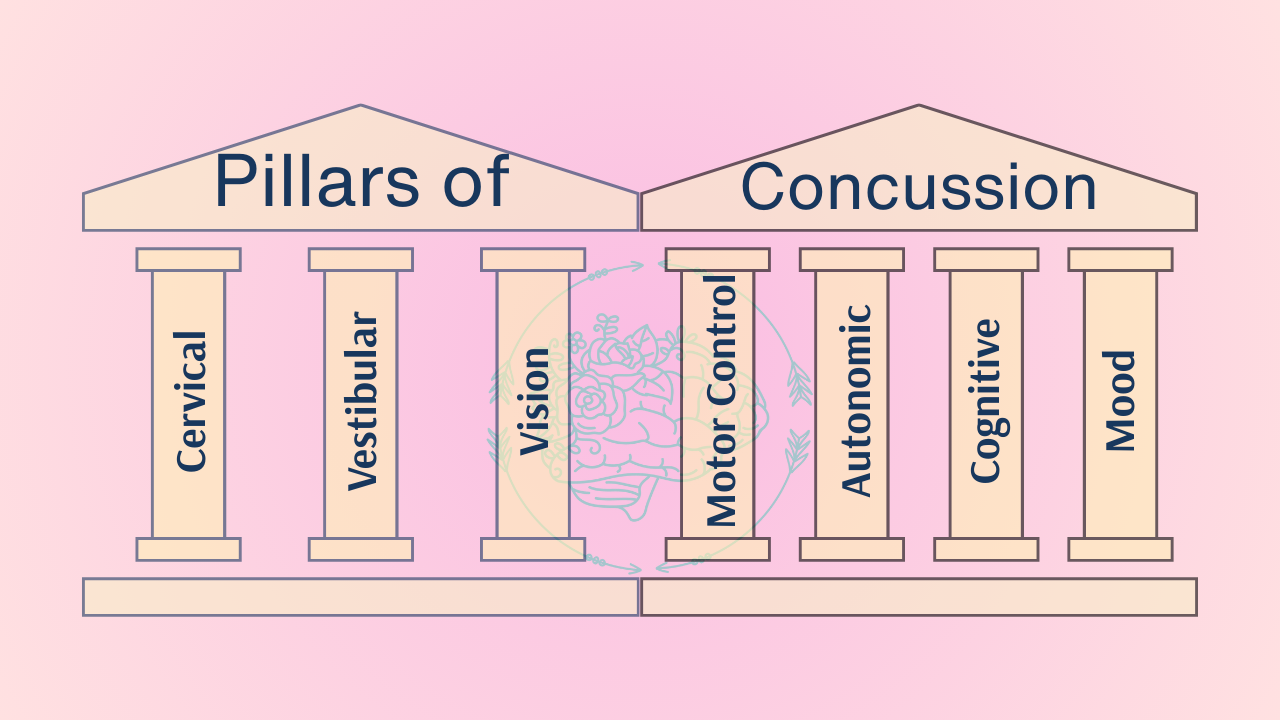
The 7 Interconnected Pillars of Concussion
1. Cervical (The Neck)
When you suffer a head injury, the massive forces involved often cause a whiplash-like injury to your neck, straining the muscles, ligaments, and joints of your cervical spine.
Symptoms: Stiff, dull headaches that start at the base of the skull, triggered by movement (turning your head, looking up) or poor posture. These are referred to as cervicogenic headaches and dizziness because they originate directly from the neck.
The Fix: Treatment focuses on deep Neck Strengthening for stability and Proprioceptive Training to teach your brain where your head is in space to eliminate movement-triggered dizziness.
2. Vestibular (The Balance System)
Your vestibular system is your body’s built-in GPS and motion sensor, crucial for balance and spatial orientation. When it's knocked offline, you feel lost in space.
Peripheral Vestibular (Inner Ear): The most common issue is BPPV (Benign Paroxysmal Positional Vertigo), where tiny crystals (otoconia) get displaced. This causes quick, intense, room-spinning dizziness (less than 60 seconds) when rolling over or looking up. This is highly treatable and should be addressed prior to central vestibular deficits.
Central Vestibular (Brainstem/Cerebellum): Injury here causes more constant unsteadiness, motion intolerance (e.g., car sickness), and persistent dizziness/nausea.
The Fix: A vestibular physical therapist can help recalibrate your system through targeted exercises. Notes that vestibular therapy is likely to trigger symptoms but should be in a controlled manner with good symptom recovery following.
3. Visual (The Oculomotor System)
Headaches, fatigue, and blurry vision after an injury often point to the visual domain. Individuals commonly think that a new prescription will fix these symptoms but your eye acuity is only 20% of the problem, the other 80% is about how your brain controls your eyes.
Symptoms: Eye strain, difficulty following a line while reading (Eye Tracking), trouble shifting focus between near and far (Accommodation), and blurry or double vision (Eye Teaming/Vergence).
The Fix: If these issues persist beyond a few weeks, Vision Therapy is crucial. It’s like physical therapy for your eyes, retraining the neuromuscular control to help your eyes track and focus together efficiently, eliminating the strain that causes fatigue and headaches.
4. Autonomic Dysfunction (The Autopilot)
Your Autonomic Nervous System (ANS) is your unconscious autopilot, regulating heart rate, blood pressure, and digestion. After a concussion, the delicate balance between the Sympathetic ("fight or flight") and Parasympathetic ("rest and digest") systems is thrown off.
Symptoms: Your body gets stuck in a state of high alert. This causes lightheadedness or dizziness with activity, sensory overload, temperature dysregulation, and debilitating fatigue.
The Fix: Rebuilding balance through graded exercise (starting slow and building tolerance), mindfulness, and targeted breathing techniques to modulate the overactive stress response.
5. Motor Coordination
Why do you still feel clumsy or unsteady, even after your headaches fade? The Motor Control domain is about how your brain coordinates simple muscle activation and complex tasks that require thinking and moving simultaneously.
The Insight: Concussion can cause the re-emergence of Primitive Reflexes—reflexes we are born with that should disappear as the brain matures. Their reappearance disrupts coordination and balance.
Symptoms: This causes impaired balance, fine motor control and coordination of movements.
The Fix: Modern concussion therapy uses Brain Body-Integration exercises. These targeted movements aim to re-integrate those reflexes and rebuild the foundational connection between your brainstem and higher-level motor systems, leading to better balance and sensorimotor integration.
6. Cognition (The Processor)
The "brain fog" you feel, difficulty focusing, slow processing speed, and memory lapses are hallmarks of the Cognitive Domain.
The Why: A concussion causes a metabolic crisis in the brain. Your neurons fire rapidly, but the fuel delivery can't keep up. Simple tasks now require massive effort, like a high-speed computer suddenly stuck on dial-up.
Symptoms: Inability to multi-task, reading the same paragraph multiple times, feeling overwhelmed by simple decisions, or struggling to find the right word.
The Fix: Cognitive pacing is essential, stopping demanding tasks before symptoms flare up to build tolerance over time. Since vision and vestibular function are closely linked to processing, improving those areas can also speed up cognitive function.
7. Mood (Emotional Regulation)
Anxiety, irritability, and uncharacteristic sadness are often direct, neurological consequences of the injury, not a weakness of character.
The Why: The jolt disrupts the delicate balance of emotional control centers (like the amygdala) and neurochemicals (serotonin, dopamine). Furthermore, being stuck in the Autonomic "fight or flight" mode leaves you wired for danger, fueling anxiety and hyper-vigilance.
Symptoms: A short fuse/snapping at loved ones, panic in busy environments (sensory overload), or apathy/depression due to brain energy depletion.
The Fix: Emotional pacing-scheduling micro-breaks to check in with your emotional state. It's also vital to work with a mental health provider who understands the neurological basis of post-concussion mood shifts.
The Critical Takeaway: They Are All Interconnected
Here is the most crucial lesson: These seven domains do not exist in isolation.
A problem in one area instantly cascades into the others, creating a vicious cycle that prevents full recovery.
For example:
If you experience motion sickness and dizziness in cars from a Vestibular issue, that triggers Anxiety in your Mood Domain, which then causes your Autonomic sympathetic drive to flare. It’s a vicious, interconnected cycle.
This is why you must seek a comprehensive, integrated treatment plan. If a provider only treats your neck, but ignores the underlying visual or vestibular triggers causing that neck tension, your recovery will stall.
True recovery requires providers that understand how to test, diagnose, and treat the complex interplay between all seven domains.
Don’t settle for partial care. Your journey back to 100% requires a holistic approach. One that treats the whole system, not just isolated symptoms. Holistic care doesn’t mean doing everything at once; it means thoughtfully layering each domain at the right time. And through it all, honoring your body’s need for pacing and recovery remains essential to meaningful progress.
Struggling to figure out where to start your concussion recovery?
Book a connection call and take the first step toward a clear, personalized plan.